
A New Era for Polymers Without Ends
The polymer industry has always advanced through catalyst innovation. Now, after decades of theoretical promise, cyclic polymers are moving toward commercial-scale production.
That shift is being driven by a breakthrough tungsten-based catalyst discovered by Professor Adam Veige and his team at the University of Florida.
Now commercialized by Oboro Labs, this catalyst makes it possible to efficiently polymerize alkynes into polymers with no chain ends, unlocking performance and sustainability advantages that were previously out of reach.
Why This Breakthrough Matters
For more than 50 years, cyclic polymers could only be synthesized in tiny laboratory quantities, making large-scale testing and commercial use impractical. Veige Catalyst™ changes that.
- Production output has been measured up to 180 million g/mol/hr, reaching commercial-scale productivity.
- Catalyst synthesis has been scaled from grams to hundreds of grams per batch.
- Cyclic polyethylene, polypropylene, polystyrene, polynorbornene, and polyacetylene are now available for customer trials and compounding.
Oboro Labs can now supply both the catalyst and finished cyclic polymers, marking a major step forward for the polymer industry.
Performance Benefits of Cyclic Polymers
Removing chain ends does more than change polymer structure. It changes how the material behaves in real-world applications.
1. Higher Glass-Transition Temperatures
In linear polymers, chain ends are often the first points of thermal motion. Without them, cyclic polymers require more energy to flow, resulting in better high-temperature performance.
2. Better Performance at Lower Molecular Weights
A lower-molecular-weight cyclic polymer can perform like a higher-molecular-weight linear polymer. This creates opportunities for lighter materials, lower cost, and improved sustainability.
3. Improved Resistance to Degradation
Cyclic polymers can delay the onset of thermal and shear degradation, which is especially valuable in demanding processing and end-use conditions.
- Extrusion processing
- Multi-cycle recycling
- High-stress applications
- Synthetic oils and viscosity modifiers
A polymer without ends can maintain performance longer under stress.
4. Stronger Electrical Performance
A University of Houston study found that cyclic polystyrene capacitors achieved significantly higher breakdown voltage.
Linear polymers contain chain ends that can act as defect sites. Removing them may improve dielectric strength and energy storage capacity.
5. Emerging Application Advantages
Early research and customer testing point to additional benefits in areas such as:
- Higher electrical conductivity
- Antifouling performance
- Lower surface friction
- Higher crystallization rates
- Reduced melt viscosity
Industry response has been strong, with multiple partners now conducting independent trials using Oboro’s materials.
Commercialization Starts Here
With support from the National Science Foundation, foundational research has moved into real-world production capability.
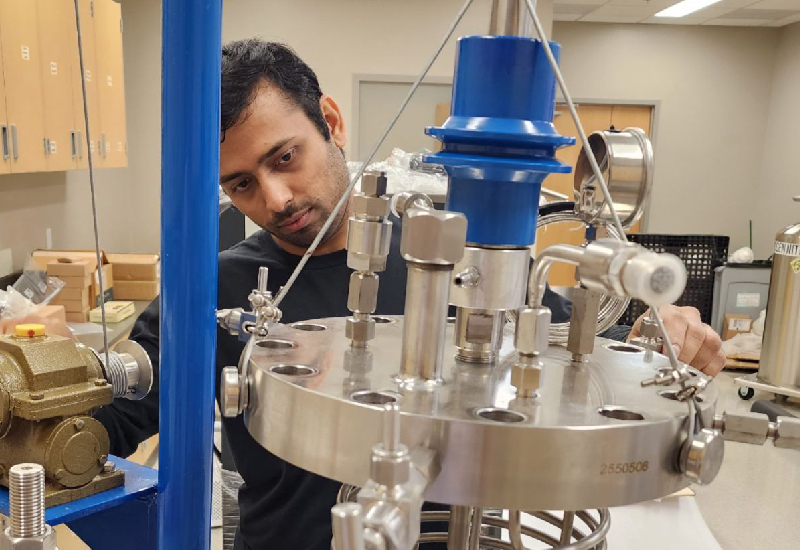
Oboro Labs now operates a custom laboratory facility focused on scaling, producing, and supplying this new family of cyclic polymers.
According to CEO Greg Kis, industry interest has been strong, with leading companies evaluating cyclic polymers for next-generation materials, electronics, additive manufacturing, and recyclability-focused product lines.
Oboro Labs is positioned to bring cyclic polymers to market at meaningful scale, opening the door to a new chapter in polymer science.
Explore our portfolio or contact us for more information.
Sources
A New Beginning for Polymers Without Ends, Plastics Technology Online
Read source article
Enhanced Dielectric Strength and Capacitive Energy Density of Cyclic Polystyrene Films, ACS Polymers Au (2022)
View DOI reference